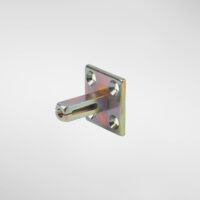
Allgood improves its 9053 fixed lever rigidiser
What is a rigidiser?
In some situations, a door needs a lever handle fixed in place without operating a latch. It may seem unusual but consider double doors across a corridor. One door contains a lock case, which requires a functioning lever handle. The other door has the strike and strike box to receive the latch bolt. The latter “slave” door only needs a push-pull operation. A standard vertical pull handle would not match the horizontal lever on the active door.
The solution is to specify the same lever handle as the active door but prevent its rotation. This allows it to function as a pull handle while maintaining symmetry in the door opening.
This blocking action uses the Allgood 9053 “rigidiser.” This is a precision-made grade 316 stainless steel bar with drilled holes for the 8mm spindle and bolt-through fittings. This version has 30-minute fire door test evidence. It can block the rotation of two opposing lever handles in a pair, or just a single handle on one side of the door (in which case a special 9052NT half spindle is required).
Improvements to the 9053 lever rigidiser
The original 9053 (shown below) was designed for single-leaf doors held shut with roller or magnetic catches without a lock case and strike box.

The product was therefore designed to sit perfectly flush with the narrow leading edge of the door.
However, our customers liked the concept so much they started to use it for double-door applications as described above. But that means cutting the rigidiser to reduce its length so there is enough space to mortice and fit the strike box on the slave door leaf. It’s no fun cutting through stainless steel – especially multiple times on a large project.
We have therefore developed a new adjustable-length rigidiser (9053N) which uses a cap that can be positioned for any of three configurations. The first is the traditional installation, where the end of the rigidiser fits flush with the leading door edge.
The second (middle) configuration withdraws the cap by 5mm from the door edge, allowing a timber plug to be inserted to match the finish of the door. This method is suitable if the end of the rigidiser should not be visible.
Finally, removing the adjustable cap completely leaves 20mm of space for the strike box to be fitted where required.
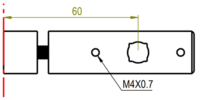
Flush to the leading edge of the door
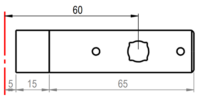
5mm back from the leading edge
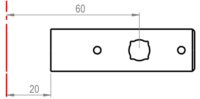
20mm back from the leading edge
Whilst redesigning the new three-in-one rigidiser we also took the opportunity to integrate fire protection more neatly.
As you can see from the new model below, we have added retaining flanges at the end of each bar section which creates a seat into which the intumescent sheet can be fitted once cut to size. This makes fitting easier.
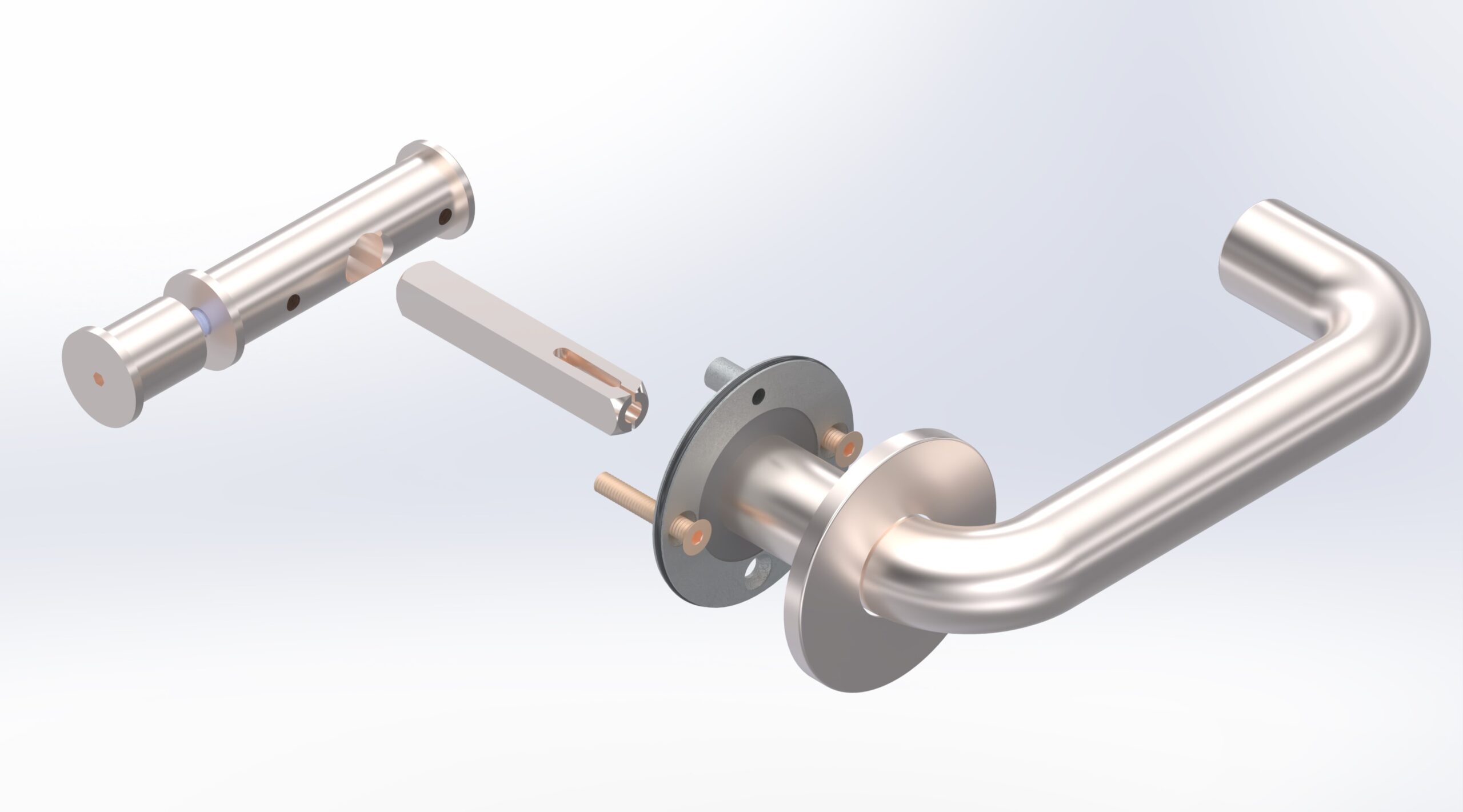
Overall, it’s a neat solution to an old problem, we think.
More details can be found here.
A word about the “Taylor Spindle” or dummy spindle
The Allgood Taylor spindle, code 9050T, is face-fixed for use with a single knob handle (“half set”), cannot be used with bolt-through door furniture, and should not be used with a lever handle because the off-centre pull and leverage action will weaken the screw fittings over time more than the central perpendicular pull associated with a knob. This arrangement is typically used in conjunction with a roller ball latch – for example on a cupboard door. The Taylor spindle is not suitable where anything more than a light force is required to open the door.