
QUADAXIAL® bearing rose
The unique Allgood lever handle mechanism
Developed and registered over 20 years ago, Allgood’s lever handle bearing system is still made in our Birmingham factory (by several of the machines and indeed people who produced the very first batch) and is supplied with every lever sold by Allgood worldwide. Why is it still so special?
Forces at play
When a door lever is used there are two types of physical force in operation – axial and rotary.
Axial forces on door levers can be tensile (stretching) or compressive and they operate perpendicular to the door face resulting from the push and pull users apply to the handle. Bearing these forces is essential for the stability and integrity of the installed lever handle assembly. The appropriate choice of materials and the method by which the parts are connected are therefore crucial.
Rotary forces (also known as torque) are those that cause an object to rotate around an axis, for example rotating a lever connected to a spindle so that it can operate a door latch. These forces need to be born in a way that ensures the movement occurs in a single plane (to avoid wobble or play).
The rose assembly (which connects the lever to the door and lock case) should bear both types of force effortlessly and without play so that the user has the feeling the lever handle is a solid and continuous part of the door. There are different rose types available, only one of which achieves that goal properly and durably.
Types of rose
There are four types of rose available in the market.
1. Ball bearing
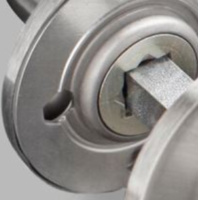
With ball-bearing roses, the axial force is loaded onto a tiny proportion of the area of the rose (i.e. onto the contact point of each bearing only) so the bearings wear over time. They also require routine maintenance with oil, which may often not be carried out, and thence suffer from rust in humid conditions. Allgood does not supply these due to their shortened life and uneven operation.
2. Circlip
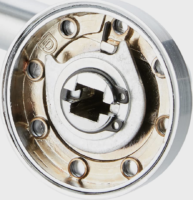
Most widely available handles are fixed to the rose or backplate with a circlip (also known as a C-clip, snap ring, or Jesus clip). The design uses washers and a circlip fitted within a machined groove in the lever shank. The clip is a semi-flexible metal ring with open ends designed to permit rotation of the lever while minimising axial movement.
Circlips allow excessive play between the rose and the lever handle, typically loosening over time so that the handle starts to wobble. From the outside, the handle looks the same as a (superior) bearing rose (see below), but never judge a book by its cover! Where tested to BS EN1906 (which is best practice) circlip assemblies would usually achieve grade 3 (high-frequency use), and occasionally grade 4 (high-frequency and violent use).
Many companies do use circlips to retain the lever handle within the rose, but due to the build-up of tolerances on the rose thickness, the groove position on the lever handle, the weakening circlip and the wearing ball bearings, no matter how much you reduce component variation, lateral play is inevitable.
3. Unattached
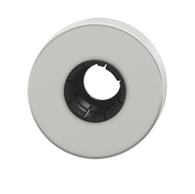
These low-cost plastic clip connectors have minimal structural strength, do not last, and give a lot of play between the handle and the rose. Unsuitable for most applications.
4. QUADAXIAL® Bearing

This is the only type of rose Allgood recommends, having developed the unique QUADAXIAL® bearing rose back in 2001. It is used on all Allgood lever handles for the reasons explained below.
What does “QUADAXIAL” mean?
The word QUADAXIAL, which is a registered trade mark of Allgood, refers to four “axial loads” and how these are managed within the lever design.
An axial load is transmitted, via bearings, along the length of an axis. In the case of a door handle, this refers to the push and pull loads which operate perpendicular to the door face, and are transmitted through the handle and rose assembly to the spindle and thence to the rose and handle on the other side. (These forces are distinct from the rotary forces or torque from the lever rotation, of which more later).
Each axial (perpendicular) load has to be resisted in such a way that the user feels no movement or “play” between (i) the lever and the rose, and (ii) between the lever assembly and the door. There are therefore two areas of load bearing on each door face, or four in total.
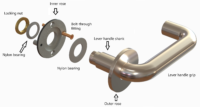
The Allgood QUADAXIAL rose achieves (i) by attaching the lever to the rose with a closed brass locking nut which ensures a good fit, at the same time as supporting side load to prevent any play or wobble. After assembly, a special chemical thread lock is applied to the locking nut.
Movement between the lever assembly and the door (ii) is prevented by two identical inner roses being fixed back-to-back on each side of the door, with metal thread screws which have easy-cut grooves in them to suit standard door thicknesses. These screws are fitted in opposite directions to maximise the clamping force.
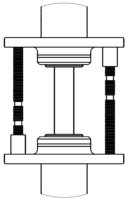
There are therefore two bearings on each lever and rose assembly set, making four bearings when the pair of levers are assembled to the spindle. When the rose-fixing back-to-back screws are assembled through the door and the stainless steel spindle screws are tightened into the spindle, the whole assembly becomes one block.
Whilst operating QUADAXIAL lever sets – whether pulling a door towards you or pushing it away – two of the four bearings come into play. If you push a door open, then the load is transmitted to the bearing between the lever and the rose bearing on the side that you are pushing against but also (through the spindle) to the bottom bearing and the inner rose of the opposite side of the door. Therefore, with every opening and closing of the door two bearings are in use. There are four bearings in total all acting down the axis of the assembly. Hence QUADAXIAL.
What about the rotary action?
With so much axial load resistance, does the free rotation of the lever get impaired?
Quite the opposite. By maintaining the strict alignment of the assembly through the door the design prevents lateral play, allowing the lever to rotate freely, resisted only by the spring in the lock. A smooth and wobble-free rotary action is guaranteed by the use of graphite-impregnated flat nylon bearings that fit into the inner rose. Due to the accuracy of the tooling, the bearings are held within the inner rose castings by fit alone, with minimum clearance.
A further refinement is the uniquely tight fit between the spindle (which has a special profile designed by Allgood) and the drifted hole in the shank of the lever. This eliminates another possible source of play.
Finally, there is a specialised interface between the spindle slots and the stainless steel cone-pointed spindle screws, preventing any movement under tension from the lever.
Materials matter
The choice of materials matters a lot.
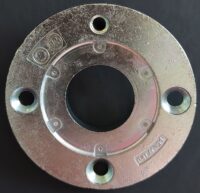
The inner rose is die-cast (in a special corrosion-resistant alloy) from a single impression tool to ensure the most accurate casting possible, allowing the creation of an inner rose bore (the central hole that receives the lever shank) with a smooth surface and soft edge to create the lowest possible coefficient of friction – protecting against wear and providing increased longevity. Most other products on the market use a cheaper stamped inner rose in steel, creating a rougher-edged inner bore which damages the lever shank over time, causing instability.
Everything other than the bearings, the inner rose and the locking nut is crafted from grade 316 stainless steel for mechanical strength and corrosion resistance.
All of these features ensure precise, solid and long-lasting management of both axial and rotary loads such that the whole assembly effectively becomes one smoothly operating block….. which is why an Allgood lever feels wonderful in the hand. For years and years.
Careful planting
All roses need to be planted in just the right position, and ours is no exception.
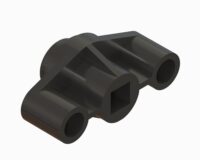
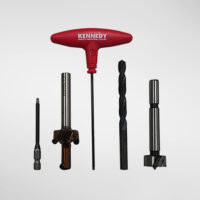
To assist the fitter we supply an 8mm drill alignment jig to help ensure the spindle and bolt-through fittings are exactly where they should be, and an optional XX9561 kit is available to aid installation.
The technical details
Tested to BS EN1906 – Grade 4
Allgood’s heaviest lever (SS3506DN 22Ø x 133 x 55mm) was mounted on the QUADAXIAL rose and surpassed 1 million cycles in testing conducted at a 3rd party mechanical testing Laboratory WIL350745. That’s 27 years of operating 100 times a day. We, therefore, offer a 25-year warranty with confidence
UK manufactured from a local supply chain
Fitting instructions are available here:
Model | QR Code |
Alite® Levers |  |
Continental® Levers |  |
Holt® Levers |  |
Modric®, Mode®, Contego®, Sembla®, SS Holt® Levers |  |