
Hinge-bearing technologies
Explaining different types of hinge design
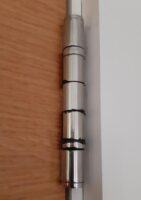
How often have you noticed a door that creaks, drags on the floor or sticks in the frame? Or perhaps hinges that appear to leak oil? This one is only 10 years old.
Usually associated with incorrectly specified hinges that have not been maintained appropriately, these issues can be avoided by correctly installing products designed to last, and manufactured to high levels of precision. Allgood hinges will function smoothly, last longer, and be less costly in the long run – for you and the planet – by minimising maintenance and avoiding replacement. Very often a failed hinge like this one will simply be thrown away and replaced by a new one of the same type, wasting procurement and labour time as well as the cost of the new hinge. This makes no financial or environmental sense.
A correctly specified, installed and maintained hinge should last decades, won’t deteriorate, and will always look smart.
In our previous technical blog, we discussed Allgood’s trademarked QUADAXIAL® rose bearing for lever handles, explaining the importance of lifelong wobble-free and maintenance-free operation. Similar considerations apply when designing and selecting the ideal hinges on which to hang doors, but with the added complication of the high load the hinges must permanently bear.
Forces at play
A common internal door in the UK is 1981mm high, 762mm wide and 44mm thick. If it is made of medium-density fibreboard (“MDF”) it will weigh about 50 kilos, or 62% of the weight of an average man. If made from high-density fibreboard (“HDF”) it will weigh about the same as an average man.
As well as attaching the door to the frame the hinges must accommodate three forces. The first two are always active, but all three are in play when the door is being used:
- The simple downward (gravitational) weight of the door exerts a shear force on the hinge screws and an axial (pushing) force on the hinge bearings.
- The lateral pull of the door (away from the hinges) increases disproportionately with door width and exerts an axial (pulling) force on the hinge screws and pin. As an example, a 25% increase in door width typically increases the mass of the door (the effective weight) by 40%. Additionally, the use of a door closer (mandatory for fire doors) will increase the effective door weight by between 20% and 75%.
- The rotary force from opening and closing is transferred through the hinge bearing.
The correct hinges can manage these forces effectively for years without maintenance, whilst allowing the door to swing easily with minimum friction.
Butt hinges
A recessed or morticed “butt hinge” is typically used and has two flaps or leaves (the right-hand one in the diagram is attached to the door and the left-hand one to the frame) connected by a pin that passes through the knuckle which also permits rotation around the axis using different types of bearings between the two flaps. When the door’s weight is on the hinge there is a lot of pressure exerted on a very small surface area (the horizontal interface between the two knuckles). When you then add the rotary force from opening and closing there is a lot of friction and potential wear on the lower bearing.
It is therefore important to understand the different types of bearings available and to assess their suitability for different situations.

Bearing types
There are five main types of bearing commonly available.
1. Plain (metal-to-metal)
This is the most basic design, where the knuckles simply sit and rub against each other.
There is no intervening material to reduce wear (which may cause the door to drop) and very regular lubrication is required.
These types of hinges are usually avoided for medium or high-usage doors.
2. Single washer
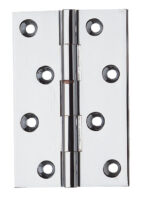
A bronze or nylon washer sits in each knuckle junction, reducing the wear and extending the hinge life. Phosphor bronze washers offer high corrosion and wear resistance. Nylon washers provide good friction reduction, but usually cannot be used on fire doors because they typically melt at 800⁰C (which would cause the door to drop and accelerate the spread of a fire). Sometimes steel washers are used, but these will also wear the face of the knuckle.
3. Double washer
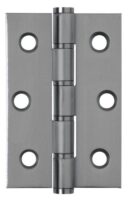
Two washers sit in each knuckle junction, and each washer should be stuck to the knuckle to ensure the washers do not move together which would cause them to wear the knuckle.
This type of hinge can be very tight and almost always requires lubrication.
4. Ball Bearings
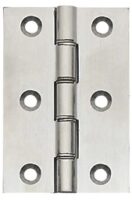
A ball-bearing race sits visibly on the lower face of a knuckle junction so that the upper knuckle rolls over the bearings, easing movement. This design gives smoother operation but is not a hinge Allgood would propose for the highest intensity use and longest life. The ball bearings are liable to rust or corrode in humid or coastal environments unless they are regularly maintained with oil or grease throughout their life. The rust will usually leak from the knuckle joint. Additionally, the balls are prone to flaking of the metal due to the elevated point pressure on the crest of each bearing.

5. Disc bearings
The aforementioned bearing types all demand routine lubrication to assist their operation, and can also wear, causing the door to drop and sometimes stick in the door frame. They can look unsightly due to eventual leakage. As a result, they have to be replaced over time, which is not good for the planet or the wallet (bearing in mind that the labour cost alone will be far more than the cost of the new hinge).
Therefore, flat disc bearings have been developed using either porous bronze (impregnated with oil) or a self-lubricating polymer. There are many advantages:
- Neither type ever needs oiling.
- Both materials will pass fire resistance tests.
- Service life is much longer. Allgood provides a 25-year mechanical warranty on these hinges.
- The bearing can be completely concealed within the knuckle, giving a smart and clean appearance with just one joint at each knuckle junction.

Allgood hinges
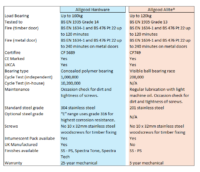
The Allgood Hardware range (but not the Allgood Alite® range) of butt hinges use the self-lubricating concealed disc bearing across our 8064, 8066, 8068, 8080 and 8081 versions. Also, the Allgood hinge pin cap is aesthetically designed to sit flush with the hinge edge, giving a neat geometrical appearance.
Like our Quadaxial® bearing rose for door levers, these hinges have been independently tested to over 1,000,000 cycles (that’s 27 years of operating 100 times a day) but internal tests have achieved 10,200,000. The highest certification level under EN 1935 is just 200,000 cycles.
The Allgood Alite® range uses a visible ball-bearing race between the knuckles and will require regular lubrication.
Technical summary
Did you know……?
When a door is closed the two flaps of butt hinges lie parallel against each other but ideally should not touch. There should be a 2-3mm gap between them which maintains that standard gap around the door edge to allow for seals whilst complying with building regulations.
Each flap of a butt hinge is morticed flush into the wood of the door and the door frame so that the door abuts the frame. Hence the “butt hinge”.

There are different kinds of pin available to connect one flap to the other through the knuckle. Most butt hinge pins can be removed, aiding installation, but some hinges feature non-removable pins to increase security. Ultra-secure hinges can have staked pins where a machine punch has forcibly deformed the knuckle to drive a dimple through it to capture the pin.
Door misalignment due to wear & tear of hinges can happen and can be reduced if the screws are periodically checked and tightened as described in our Hinge Maintenance Guide to keep the hinges aligned.
Our fixing instructions for hinges can be found here
